Image SEO: what actually matters
Image SEO attracts more superstition than most corners of the field. Google publishes what it wants fairly plainly, and almost none of it involves stuffing keywords anywhere.
Alt text is an accessibility feature first
Alt text exists so that people who cannot see the image still get its meaning — screen reader users, and anyone whose image failed to load. Google reads it too, and explicitly asks for descriptive text rather than keyword lists1.
The W3C guidance is the clearest test available: describe the image's function in context, not its appearance in isolation2.
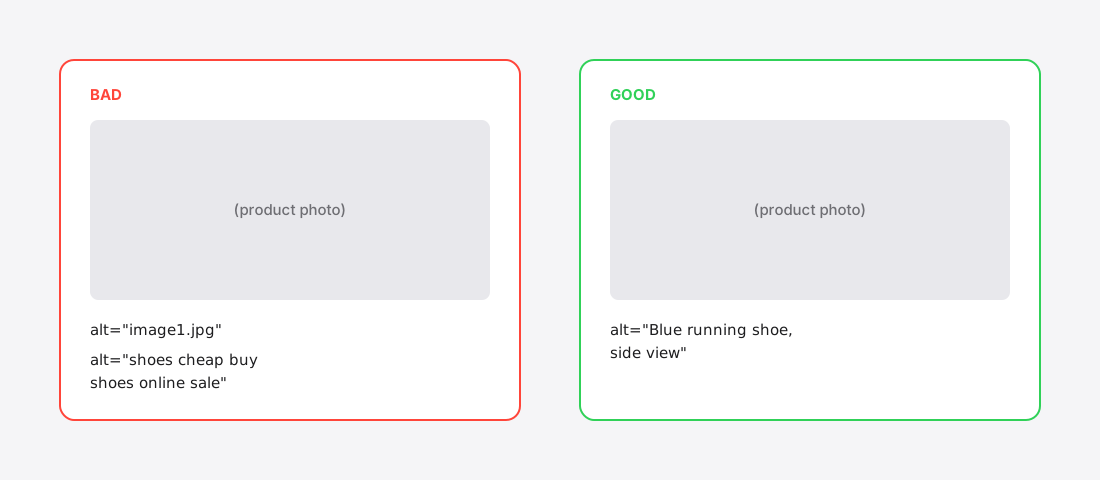
A product photo is not alt="image" and not alt="blue running shoes cheap buy online shoes". It is alt="Blue running shoe, side view".
Decorative images should have empty alt
If an image carries no information — a divider, a background flourish, an icon next to a label that already says the same thing — the correct alt text is empty: alt=""3.
Empty is not the same as missing. alt="" tells a screen reader to skip it. Omitting the attribute entirely leaves the reader to announce the filename, which is worse than silence.
Filenames do a small, real job
Google states that the filename gives it clues about the image's subject1. golden-retriever-puppy.jpg is genuinely more useful than IMG_20260117_5512.jpg.
This is worth doing and not worth agonising over. Rename descriptively, use hyphens, move on.
The parts that actually move the needle
- Page speed. Image weight feeds LCP, and page experience is a documented ranking consideration4. This outweighs alt-text micro-optimisation by a wide margin — see why images slow sites down.
- Surrounding text. Google uses the content near an image to understand it1. An image inside relevant prose is understood better than one floating in a gallery.
- A real sitemap entry. If images matter to your site, list them so they can be discovered1.
- Stable URLs. Ranking accrues to a URL. Shuffling image paths on every redesign discards it.
Things that do not work
Keyword-stuffed alt text is called out directly by Google as something to avoid1. Hidden text behind images, alt attributes written for crawlers rather than people, and "SEO filenames" packed with terms are all in the same category: effort spent on something that either does nothing or actively counts against you.
Write the alt text you would want read aloud to you. That is the whole technique.
Writing alt text that is actually useful
The test is functional, not stylistic: if this image failed to load, what sentence would let the reader carry on without losing anything?
That reframing settles most of the hard cases. It rules out keyword stuffing, because a stuffed string is useless read aloud. It rules out redundancy, because repeating the adjacent caption adds nothing. And it rules out “image of” and “photo of”, since screen readers already announce that it is an image.
Length follows from the same test. Most images need a short clause. A chart may need a sentence or two conveying what the data shows, because that is the information the image carries — describing a chart's appearance rather than its finding is a common miss.
Empty alt is a decision, not an omission
alt="" and a missing alt attribute are different things, and the difference matters for accessibility.
An empty alt tells assistive technology the image is decorative and should be skipped. A missing attribute leaves it undefined, and screen readers commonly fall back to reading the filename aloud — which is how a user ends up hearing “I M G underscore 4 7 2 9 dot j p g”.
So: purely decorative images get an explicit empty alt. Every other image gets real text. The one case never to leave to chance is an image inside a link with no other text, where the alt becomes the link's accessible name — omit it and the link is announced as its URL.
Where alt text fits among the other signals
Alt text is one input among several, and treating it as the whole of image SEO leads to over-investment in one attribute and neglect of the rest.
The filename is a genuine if minor signal. golden-retriever-puppy.jpg tells a crawler something; IMG_4729.jpg does not. Rename before upload — renaming afterwards breaks existing links.
Surrounding text carries more weight than either. Search engines read the caption, the heading above the image and the paragraph around it to understand what the image depicts. An image placed in genuinely relevant context is understood better than one carrying a keyword-stuffed alt attribute in a vacuum.
Page speed affects images too. An image that loads slowly, or shifts the layout when it arrives, hurts the page it sits on regardless of how well described it is.
Structured data lets you state explicitly that an image belongs to an article or product, rather than leaving it to be inferred.
Getting alt text right is worth doing and takes minutes. It is not a substitute for the image being relevant, well-named, in context, and fast.
References
- Google Images SEO best practicesGoogle Search Central↑
- Images TutorialW3C Web Accessibility Initiative↑
- Decorative ImagesW3C Web Accessibility Initiative↑
- Understanding page experience in Google Search resultsGoogle Search Central↑